
Wallpaper vs Paint: Which is Better for Indian Homes in 2026?
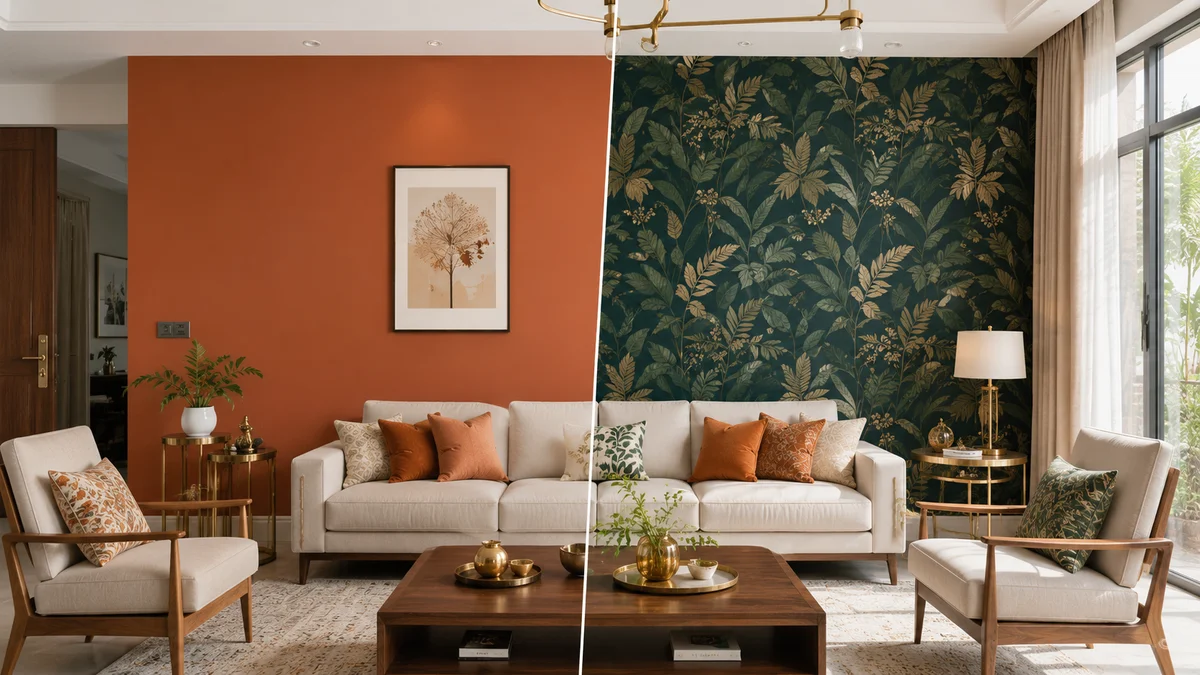
Your palette is chosen; you have flipped through countless inspirational boards, and here you are at a crossroads like all other Indians – to wallpaper or not to wallpaper?
It seems quite simple. However, when you consider that Indian homes face harsh summers, extreme monsoons, and daily dust, there is a possibility of incurring expenses and frustrations. Our experts at HomeGlazer have over 35 years of experience helping homeowners in Delhi, Noida, Gurugram, Faridabad, and Ghaziabad make these decisions. We have prepared this comprehensive guide for anyone looking to make the right decision for their home.
What is the Difference Between Paint and Wallpaper?
Paint is a liquid that is put on your walls directly, layer upon layer. In fact, it has always been the standard coating on the walls of houses in India, and there is a reason why – it is cheap, versatile, and suitable for all rooms.
But wallpaper is simply a prefabricated decorative paper which can be of vinyl, non-woven fabric, paper, or self-adhesive type; this is attached to your walls by means of an adhesive. It offers you design capabilities which are not possible through paint, such as photographic murals, geometric designs, fabric texture designs, botanical designs, and much more.
Both are good choices. What matters is realizing which one is right for you.
Wallpaper vs Paint: Cost Comparison in India (2026)
The price factor is most often what comes to mind first when Indians look for houses. Let's cut straight to the chase.
Interior paints, when speaking of standard emulsions by Asian Paints, Berger, and other companies, usually cost around ₹20 to ₹40 per square foot (including labour). If premium emulsions like those by Royale and Dulux Velvet Touch are used, they will set you back anywhere between ₹40 and ₹80 per square foot.
As regards the wallpaper, the price for ordinary or self-adhesive wallpaper will be approximately ₹35 to ₹90 per square feet including the installation cost. The ordinary imported wallpaper comes at ₹80 to ₹190 per square feet. Designer wallpapers come for above ₹200 per square feet.
On the face of it, paint appears to be more economical than wallpaper initially. Paint requires renewal within 5 to 7 years owing to its tendency to fade, acquire water marks, and deteriorate. Wallpaper, on the other hand, when correctly fitted into an appropriate dry indoor environment, will serve its purpose for at least 8 to 12 years.
Best way to go for the majority of houses in Delhi NCR? Apply paint to your walls in most rooms and select wallpaper to be applied just on the accent wall of each room. This will provide you with a luxurious look at a very economical rate.
How Does Each Option Perform in Indian Climate?
This is where things get practical. The climatic conditions in India constitute the biggest drawback for wallpaper.
On the other hand, paint works great under hot and humid weather. Waterproof and washable versions have been introduced by all major paint manufacturers. It is more durable against flaking off due to monsoon rains compared to wallpaper. Small imperfections caused by scratches can be easily touched up with no need to repaint the whole wall.
Wallpaper functions excellently in dry conditions, such as living and bedroom spaces. Nevertheless, wallpaper is highly susceptible to moisture. In spaces that lack proper ventilation or that had any experience of water seepage in the past, the edges of the wallpaper start lifting within a few months of their application. Spaces like the kitchen and bathroom in Indian households are usually not appropriate places for wallpapering. In old houses situated in regions such as NIT Faridabad, Ghaziabad, or East Delhi, painting is more prudent.
In conclusion, when it comes to climate performance, paint is the winner for adaptability in all Indian climates, while wallpaper takes the crown indoors where humidity levels are low.
Design and Aesthetic Versatility
When design effects are more important to you than anything else, wallpaper comes out as the victor, and not even close.
The modern paints can come in thousands of colours, many different finishes (flat, eggshell, satin, and semi-gloss), as well as various decorative textures, like stucco, Venetian plaster, or even stencil work. These are truly gorgeous choices, although they have their limitations due to the medium used.
Wallpaper does many things that paint cannot — from photographic wall murals to deep botanicals, textured grasscloths and linens, metallic foils, and even damask designs that repeat flawlessly throughout. For accent walls in a dining room or for a focal wall in the master suite, wallpaper provides the effect that nothing else at this price point will be able to match.
The current trend in premium housing developments in Gurugram, Greater Noida West, and South Delhi involves the use of what is termed as the "wall formula," which comprises three walls being painted in premium emulsion and the fourth wall being done in statement wallpaper.
Room by Room Selection Guide: Which One to Select?
The combination option is best suited for living rooms where the walls except for the one with television are painted while the accent wall can be wallpapered. The accent wall behind the bed in the master bedroom with painted other walls gives the look of a boutique hotel suite.
In case of children’s rooms, emulsion paint should be used since it is easily cleaned after crayon marks, can be changed easily according to changes in taste preferences, and does not involve any moisture hazard posed by wallpaper. In case of kitchen and bathroom walls, painting is inevitable due to the humidity of these environments in Indian conditions.
It could be said that wallpaper reaches its peak potential when applied to dining rooms, which are low-traffic areas and where it can stay in good condition for many years to come.
Maintenance: Which One Is Less Troublesome?
Today's vinyl wallpapers can be cleaned easily; even the toughest stains can be removed by just wiping them with a moist cloth. Yet once torn or nicked, it is nearly impossible to fix such spots without leaving visible traces of repairs. In case the wall covering comes off or gets scratched, one might have to remove the whole piece, so it's necessary to keep spare wallpaper rolls.
Paint is much more economical and easier to maintain. Repairs are easy, do not involve much expertise, and leftover paint from the initial project will suffice. Paint's restorability becomes especially valuable in high traffic zones such as hallways, doorways, and playgrounds.
Conclusion Home Glazer’s Opinion
There is no such thing as one best solution between wallpapers and paint. The ideal choice can be different for each person, depending on his or her home, circumstances, and budget. In India, however, premium emulsion paints will prove to be a better option for most homeowners.
Yet, for certain selected areas, such as a dining room, a headboard wall of the master bedroom, or even a living room accent wall, the use of professionally applied wallpaper provides an unmatched level of design impact compared to paint at the same price point.
HomeGlazer makes sure that you get the right selection for all the walls of your home. It is up to you whether you select the best paint, or wallpaper, or textural painting, or any combination thereof, but rest assured that we will deliver excellence in everything.
Get in touch today for a free site visit and consultation across Delhi, Noida, Gurugram, Faridabad, and Ghaziabad.
📞 +91 97172 56514 | homeglazer.com/enquiry